When the Scales Tip: What AI Taught Me About Bridging and Bias
What does knife crime in London have to do with AI? More than I expected.

Ever in search of bridging, those moments when people connect across difference, I recently spent an intense three days in London at a unique gathering.
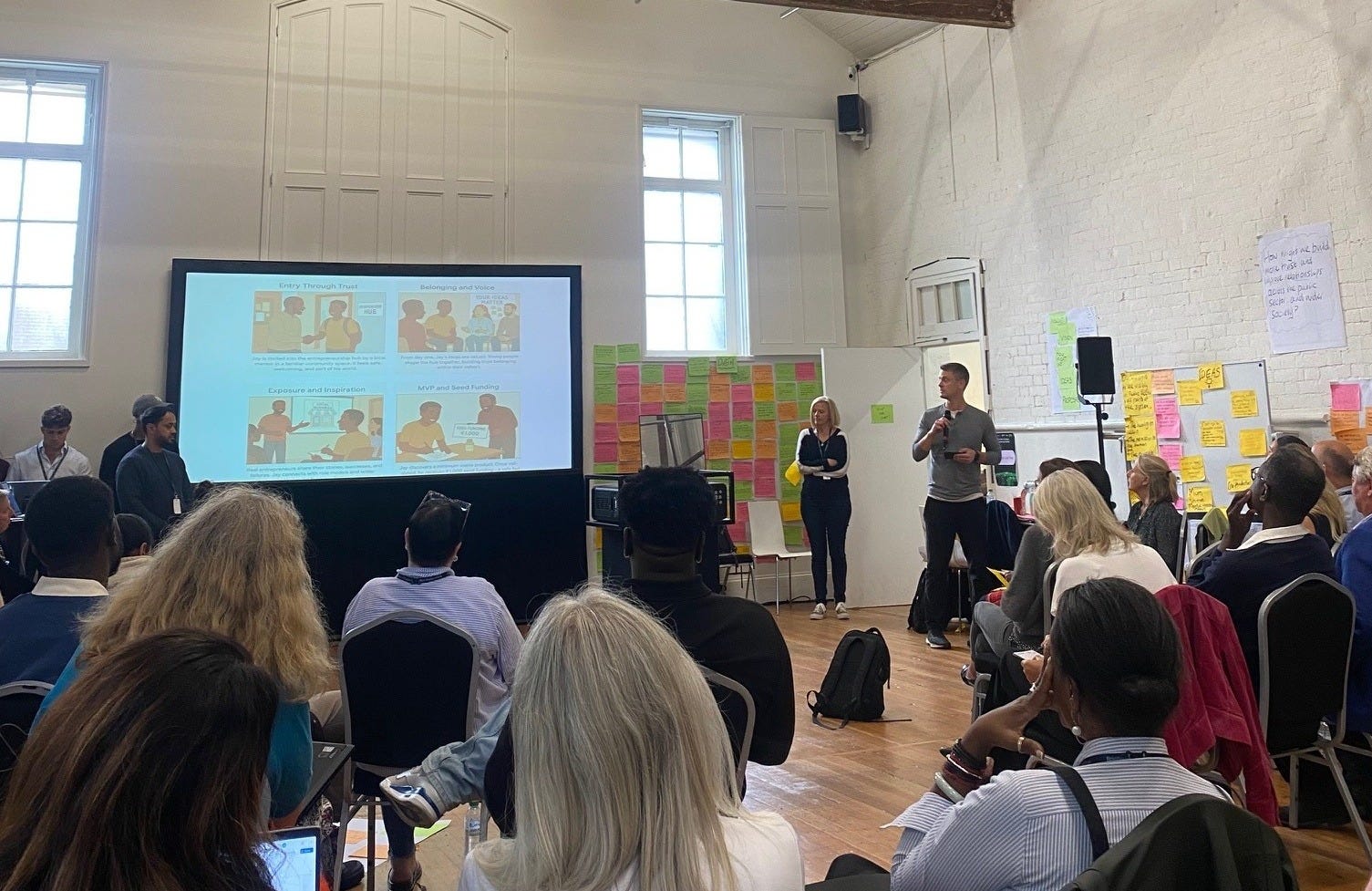
The Bridge Institute had brought together an extraordinary mix: government leaders, police officers, young people, community organisers, business executives, and judges. Our mission? The Safe Life programme, tackling knife crime in London and creating hope for the young people most affected.
Normally my interest is in the process of bridging rather than the topic – I tend to be issue agnostic. I’m interested in how bridging happens. Who needs to be involved? What is a human question that will act as a magnet to bring different voices together? What does an effective bridging space look like? But this time felt different.
Our focus for three days was life and death.
The Conversation That Stopped Me
My first conversation was with a stranger in the next seat. After some chit-chat, we discovered common ground: both mums, both raised near London, both with Oxford connections. I asked about her child, mentioning my older kids had just finished university.
“My son was killed by a single stab wound,” she replied, with a grace that left me speechless.
How is it possible that knife crime is an alien experience for some UK children and a daily reality for others?
Immersed in Imbalance
To help us answer that question, we had the opportunity to speak with a judge at the Old Bailey. Asked what keeps her awake at night, she described the desolate loss of giving a 16-year-old child a minimum sentence of 21 years for murder and all that stood for – the child killed, the child imprisoned, and the families left behind – all lives lost.
As we walked through the majestic halls, I chatted with a young man who’d only ever entered through the bowels of the building as a prisoner on remand. This was his first time through the front entrance. We stood together before an image of the scales perched on the building’s roof. The symbol of Lady Justice represents balance and equity but crime doesn’t always come from a place of equity. We may be born equal but what follows emerges from a complex web of difference.
The scales are anything but balanced.
Our Task: Level the Scales
Back at the Organ Factory in East London, our team (community leaders, business leaders, charity workers, innovators) focused on one piece of the puzzle: creating entrepreneurship opportunities for young people on London’s estates.
The imbalance revealed itself immediately.
I’ve worked at Cambridge and Oxford universities. I know what sophisticated entrepreneurship support looks like: end-to-end ecosystems that walk alongside founders from first idea through to investment. When I arrived at Hoxton station that morning, I could see Canary Wharf’s gleaming towers on the skyline, a place of opportunity and the polar opposite of the estates.
My teammates from the local estates shared a different reality. Yes, there is entrepreneurial energy in their communities, rooted in the informal economy but the visual link to the City was the only one. Where was their route into that same entrepreneurship system?
Together we researched and the statistics, when you can find any, are brutal. The inequalities stack up in multiple ways. Geography, class, race, gender. Take one example: in the ten years to 2019, only 0.24% of all UK venture capital went to Black founders. Black female founders fared even worse, receiving only 0.02% of the total invested capital across that time.
Less than 1%.
When AI Showed Us the Problem
Then something fascinating happened.
To test our thinking, I fed our entrepreneurship ideas into AI. It came back with suggestions for small community enterprises requiring local volunteers. Modest, well-meaning but hugely limited. Why? Because I’d given it profiles of people from the estates.
Out of curiosity, I wondered: what if I’d entered the profile of a City investor instead? The answer was obvious. I’d have received completely different suggestions – bigger scale, venture-backed and connected to capital.
Even our algorithms encode the imbalance.
That moment crystallised everything. The question isn’t whether people on the estates need entrepreneurship support. It’s whether they get access to the same quality – the full ecosystem, not a community-volunteer version.
Who Tips the Scales?
Here’s what successful bridging taught me that week: those with lived experience must lead. They have the trust, knowledge, and contextual expertise that no outsider can replicate.
But (and this is critical) they need support from people who’ve witnessed the other side of the scales. Not to lead. Not to decide but to help access the same resources, networks, and opportunities that have always existed elsewhere.
That’s how you level the scales. Not by creating separate (lesser) systems but by extending the full weight of existing opportunity to everyone.
Together, we can relevel the balance.
The Test
The test of any bridging work, for me, is simple: does change actually happen and who’s involved in making it real? Is there genuine catalysis that goes beyond where any of us could reach alone.
We left that week energised and committed. Top of our list: finding the right champion to help catalyse real change.
Anyone have Steven Bartlett on speed dial?
But the deeper question lingers. We spent three days watching the scales tip back and forth. Old Bailey to estates, privilege to exclusion, algorithms to lived reality.
The question now is: which side will we add our weight to?
I’d love to hear your experiences. Where have you seen imbalance? What did it take to tip the scales